Business systems / Development & production testing
ERP Grande.
A garment-production ERP connecting customer purchase orders, material workflows, piece barcodes, department scanning and production reporting.
Private business project · public workflow overview
What needed
to work.
Keep operational records traceable from orders and material movements through production stations, finished pieces and reports.
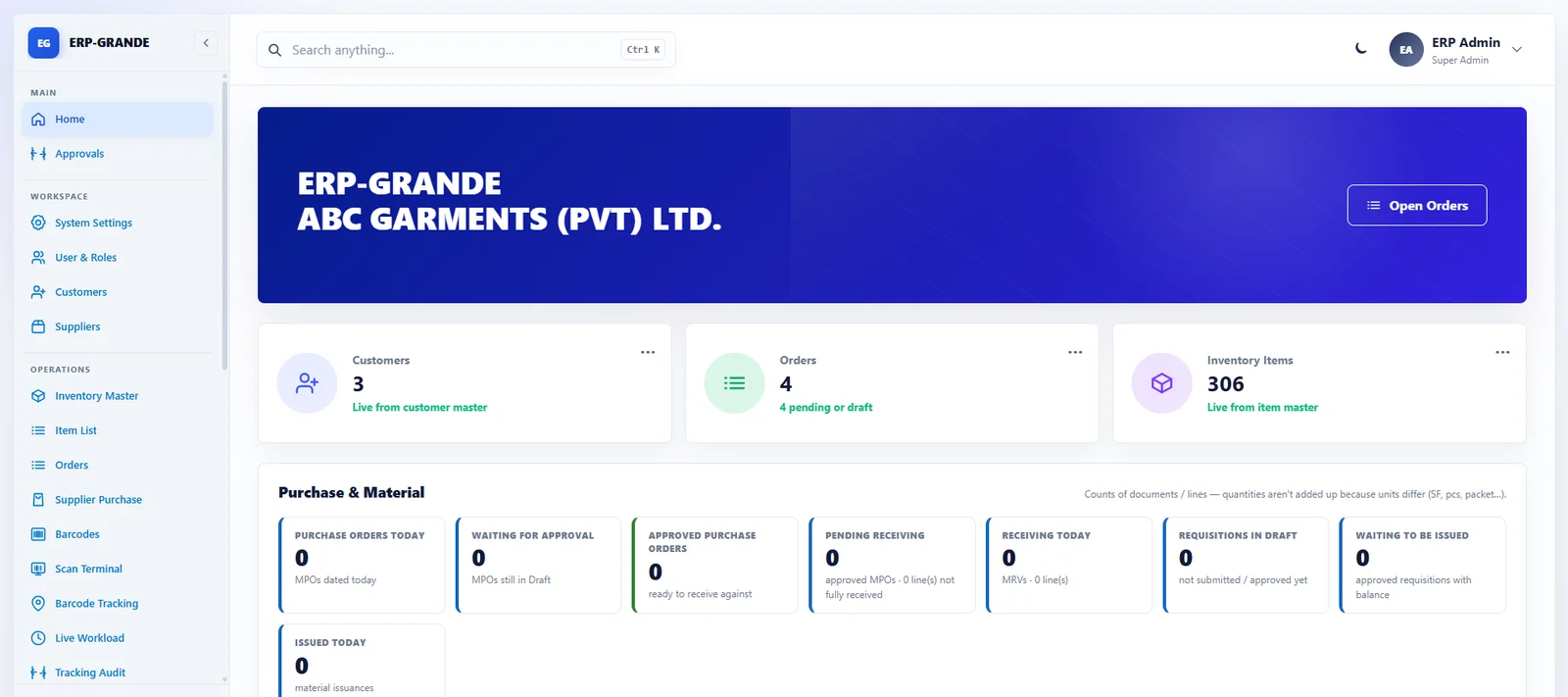
ERP Grande connects garment manufacturing records across orders, materials, production, scanning and reporting. The public demonstration dashboard accompanies an overview of how those records connect.
Customer purchase orders, material documents and piece identifiers give production activity a common operational context. Department station scans, workload views and PDF reports make that activity reviewable.
Public workflow overview and demonstration artwork only. Private customer records, source code and deployment access are not shared. Development/testing status follows the original project record; the public showcase does not establish a production release.
One piece.
A connected record.
- 01Customer purchase order
- 02Production batch
- 03Piece barcode
- 04Department station scan
- 05Production tracking
- 06Reporting
Conceptual process illustration.
- 01 / Customer purchase order
Customer purchase order
Customer purchase orders (CPOs) include size breakups and approvals.
- 02 / Production batch
Production batch
Customer orders connect to production batches.
- 03 / Piece barcode
Piece barcode
Per-piece barcode identifiers support traceability through manufacturing.
- 04 / Department station scan
Department station scan
Department-wise scanning records activity against piece identifiers.
- 05 / Production tracking
Production tracking
Production records sit alongside worker workload, filtering and reassignment.
- 06 / Reporting
Reporting
Daily production and work-progress PDFs provide reviewable output alongside AQL quality checks.
Give every layer
a purpose.
- ASP.NET Core MVC (.NET 10)
- A server-rendered MVC business application supports the garment-production workflows.
- SQL Server & Entity Framework Core
- SQL Server and Entity Framework Core provide the application’s relational data layer.
- Barcode workflows & QuestPDF
- Per-piece identity, station activity and production records feed workflow views and PDF reporting.
ASP.NET Core MVC (.NET 10) / SQL Server / Entity Framework Core / QuestPDF
The work
I contributed.
Business workflow implementation across data, role permissions, production records, barcode flows and reporting.
.NET and SQL development were learned and applied according to project requirements, with AI-assisted planning, debugging and review.
Implementation details
- Purchase-order size breakups and approvals; model bills of materials, cost sheets and procurement plans.
- Material requisition, issuance and receiving vouchers connect inventory-related operational records.
- Piece barcode flows, department scanning, live workload and reassignment support production tracking.
- Role permissions and reports form part of the recorded individual contribution.
Details that
make it useful.
- 01
Customer purchase orders with size breakups and approvals
- 02
Material requisition, issuance and receiving vouchers
- 03
Model bills of materials, cost sheets and procurement plans
- 04
Per-piece barcodes and department-wise station scanning
- 05
Live worker workload, filters and reassignment
- 06
AQL quality checks, daily production and work-progress PDFs
Where the
details matter.
- 01
Retaining the identity of a piece as activity moves between departments and stations.
- 02
Keeping order, material, workload and production views coherent across the workflow.
- 03
Presenting operational progress and quality records in reviewable reports.
Nexvora Workspace↗